

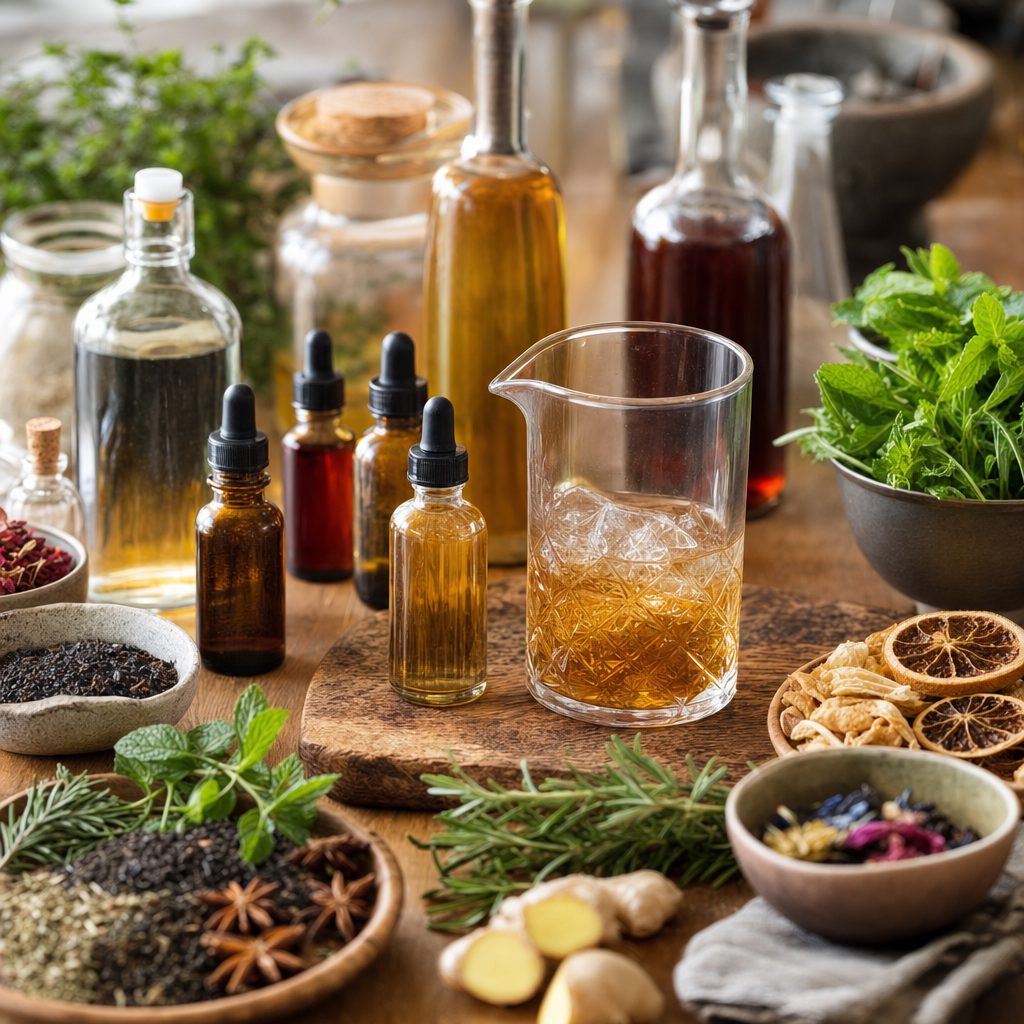
Take the alcohol out of a classic cocktail and you lose more than the buzz. Ethanol is structural. It carries volatile aromatics up to your nose, gives a drink weight on the tongue, and delivers the faint warmth that reads as a grown-up drink. Pour the same recipe with water where the spirit used to be and it tastes hollow, even when every other ingredient is identical.
Let’s be honest up front: nothing replicates ethanol exactly, and any zero-proof recipe claiming otherwise is overselling. What you can do is rebuild each of alcohol’s jobs separately, with tools that already exist in your kitchen or are easy to order. Building flavor without alcohol is a craft of substitutions, and once you learn the five levers below, you can diagnose and fix almost any flat mocktail.
Body: Give the Drink Some Weight
Water is thin. Ethanol, perhaps surprisingly, is not: it adds viscosity and a sense of roundness. The most direct replacement is sugar concentration. A rich syrup made with two parts sugar to one part water adds noticeably more weight per ounce than standard one-to-one simple syrup, so you get body without extra volume.
Sugar concentration is measured in brix, which is just the percentage of dissolved sugar in a liquid. We covered the details in What is Brix?, but the working rule is simple: higher brix means more body from less liquid.
Beyond sugar, there are other body builders. Honey and maple bring weight plus their own flavor. Strongly brewed black tea contributes tannin and a satisfying fullness. Many commercial NA spirits lean on glycerin, a clear plant-derived liquid that adds slickness without sweetness, and a small bottle of food-grade glycerin can do the same at home.
Texture has one more lever: bubbles. Aggressive carbonation gives a drink a prickly liveliness that reads as structure in your mouth, which is part of why so many zero-proof builds default to the highball format. If a still drink tastes flabby and more syrup does not fix it, topping it with sparkling water often will.
One caveat before moving on: sugar brings sweetness along with weight, so every addition needs balancing acid or bitterness. Which brings us to the next lever.
Bitterness: The Backbone
Bitterness is the most common missing piece in homemade zero-proof drinks. It is the thing that makes a drink taste adult instead of like juice, and conventional cocktails get it almost for free from spirits, cocktail bitters, and amari, the Italian family of bitter herbal liqueurs.
You can build it from scratch. Gentian root, the intensely bitter root behind many European aperitifs (an aperitif being a light, usually bitter drink served before a meal), can be simmered into a syrup. So can grapefruit peel. Cinchona bark is the source of quinine, which is why plain tonic water is a legitimate bittering ingredient. Deliberately over-steeped black tea works too, and so does a short shot of strong coffee in darker builds.
The easier route is bottled. Non-alcoholic aperitifs have become genuinely good, and brands like Little Saints and Ghia are built around exactly this kind of botanical bitterness. A half ounce stirred into an otherwise sweet, juicy drink changes its whole posture.
Aroma: The Heavy Lifter
Ethanol evaporates readily, and aromas ride it up out of the glass. This is why NA drinks so often smell muted, and why you have to compensate deliberately. Express citrus peels: squeeze the peel skin-side down over the drink so its oils mist the surface. Slap herbs between your palms before garnishing to wake them up. In a zero-proof drink, the garnish is not decoration; it is an ingredient.
Extracts are the other big tool. These are concentrated flavorings, and liquor-style versions aim to deliver rum, bourbon, or amaretto character in drops rather than ounces. We tested a range of them in our look at OliveNation’s liquor extracts. Honest assessment: they read as flavor, not as spirit, but in the right drink that is exactly enough. Start with two or three drops, because they are easy to overdo.
For smoke, brew lapsang souchong, a pine-smoked black tea, and use it as your base liquid or freeze it into cubes.
Salt and Acid: The Seasoning Levers
Keep a small dropper bottle of saline solution near your shaker: one part salt dissolved in four parts warm water. Two or three drops in a finished drink does what a pinch of salt does to food. It rounds off harsh bitterness, amplifies aroma, and makes fruit taste more like itself, all without making the drink taste salty.
On the acid side, go beyond lemon and lime. Verjus, the pressed juice of unripe grapes, is gently tart and wine-adjacent with no citrus aroma, which makes it useful in stirred, spirit-style drinks where lime would smell out of place. A splash of a fruit shrub (a syrup of fruit, sugar, and vinegar) brings acidity and depth at the same time.
Bite: Heat Where the Burn Used to Be
Ethanol’s burn is a physical sensation, and nothing non-alcoholic recreates it precisely. The closest stand-ins are other forms of gentle heat: fresh ginger juice, a black pepper syrup, or a single thin coin of jalapeno shaken into the drink. To be clear, these read as spice rather than booze. But they give a drink edge and length, and they keep the last sip as interesting as the first, which is most of what the burn was doing anyway.
The Starter Pantry
You do not need all of this at once. A practical starter kit: a jar of rich simple syrup, a dropper bottle of saline, one bottled NA aperitif or a homemade grapefruit and gentian syrup, a couple of extracts, a box of assertive black tea, and fresh citrus, always.
Then, the next time a zero-proof drink falls flat, run down the list. Does it need weight? Bitterness? Aroma? Salt? Bite? Fix one lever at a time and taste as you go. That habit, more than any single ingredient, is what building flavor without alcohol actually means.
